You shouldn’t pay a 4% commission just to understand a contract. On Canada’s average $625,000 home sale, that’s $25,000 you could keep instead of handing over to someone who explains paperwork. Smart sellers are taking control and keeping more equity.
The truth is, a home purchase agreement Canada sellers use has standard clauses you can learn to navigate. You can review offers, negotiate terms, and protect yourself without paying traditional agent fees. ComFree provides the templates, guides, and support to handle your sale confidently while saving thousands.

A Canadian home purchase agreement might look intimidating, but it’s really just a detailed contract covering who’s buying what, for how much, and when. Understanding what is included in a home purchase agreement in Canada puts you in control of negotiations and helps you spot red flags before they become problems.
Every valid purchase agreement starts with the fundamentals. You’ll see the buyer’s and seller’s full legal names, the complete legal property description (not just the street address), the purchase price, and the deposit amount. The buyer typically has 24 to 48 hours to make their offer irrevocable, meaning they can’t back out during this window. This irrevocable period protects you from buyers who submit offers without serious intent to purchase.
Most offers come with conditions that buyers must satisfy before the sale becomes firm. Financing approval and home inspections are standard, usually requiring 5 to 10 business days to complete. In Ontario, buyers often need time to review the condo status certificate, which can extend timelines to 7 days. Some buyers include a condition to sell their current home first, which can stretch up to 18 days or longer. Shorter condition periods generally favour sellers and create urgency for buyers.
Sellers should focus on inclusions and exclusions, which specify what stays with the house and what you’re taking with you. For example, are the custom window treatments included or excluded? Representations and warranties outline what you’re promising about the property’s condition. Title insurance, closing adjustments for utilities and taxes, and the firm closing date all need clear language. The agreement should also spell out what happens if either party wants to terminate and how disputes get resolved through mediation or arbitration.
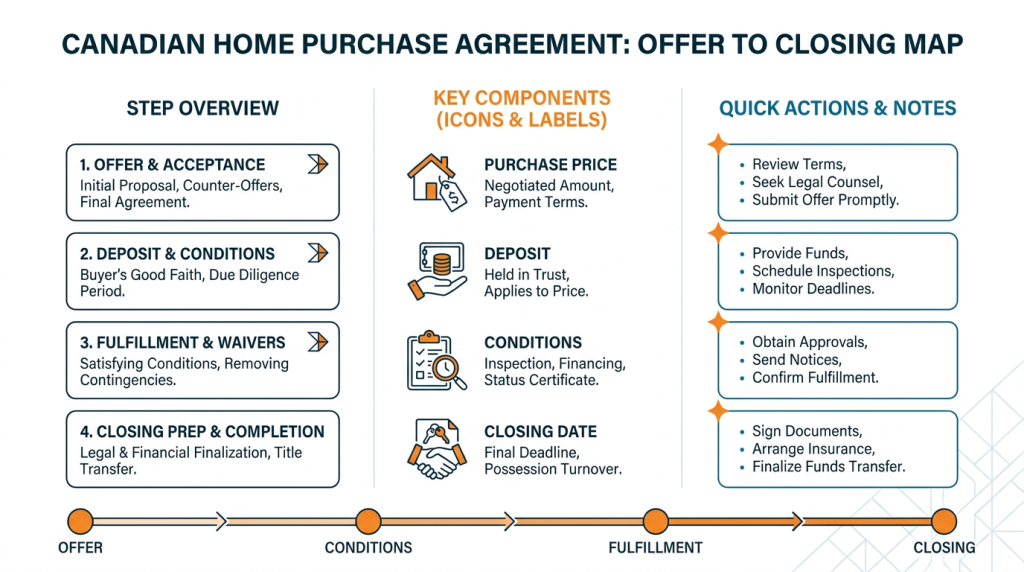
When you receive an offer, you have the power to negotiate terms that protect your interests and keep the sale moving forward. Here’s your step-by-step purchase agreement Canada review process to make changes that work in your favour:
Remember, every change you make to an offer creates a counter-offer, so prioritize the terms that matter most to your situation and timeline.
Understanding how sellers can protect themselves in a Canadian home purchase agreement starts with using leverage strategically. Require proof of funds or a pre-approval letter with every offer, and demand a deposit of at least 5% of the purchase price within 24 hours of acceptance. For example, on a $500,000 offer, that’s a $25,000 deposit showing real commitment. Set your irrevocable period to 24–48 hours maximum to prevent buyers from shopping around while tying up your property.
Beyond securing strong offers, protect yourself by being specific about inclusions and exclusions in your agreement. List rental items like water heaters, security systems, or furnaces clearly to avoid closing day surprises. Keep your warranties factual and narrow rather than making broad promises about the property’s condition. If you’re in Ontario and selling a condo, require the buyer to review the status certificate within the standard timeline, giving you an out if they find issues you can’t reasonably address.
Legal questions about purchase agreements shouldn’t intimidate you when selling your first home. Here are the straightforward answers that help you make informed decisions and stay in control of your sale.
Yes, electronic signatures are legally binding across Canada under provincial Electronic Transactions Acts. The agreement becomes valid when both parties sign, whether digitally or on paper. Most real estate platforms now use secure e-signature technology that meets Canada’s legal standards for home purchase agreements.
A binding agreement needs both parties to agree on price, property details, and closing date. Once signed within the deadline, you’re both legally committed. Both buyer and seller must be legally able to enter the agreement, and the transaction must be lawful to be enforceable.
While not legally required, most sellers benefit from legal review, especially for complex transactions or unusual clauses. Many sellers have their lawyer review the agreement after acceptance but before conditions are removed. This timing protects you while keeping costs reasonable, typically $500–$800 for residential transactions.
Deposits typically range from $5,000–$25,000 depending on purchase price, payable within 24–48 hours of acceptance. Financing conditions usually run 5–7 business days, inspection conditions are often 3–5 days. Shorter timelines favour sellers, so negotiate based on your market position.
Absolutely. You can accept backup offers even with a conditional primary offer in place. The backup offer should include an escape clause allowing the primary buyer to remove conditions first. This strategy gives you security if the first deal falls through while keeping your options open.
ComFree provides step-by-step guides and contract templates that help you navigate these legal aspects with confidence, so you can focus on getting the best deal for your home.
Understanding your home purchase agreement puts you in the driver’s seat when offers arrive. You can negotiate smart terms, protect your interests and secure the best offer without paying a 4% commission to someone else.
The financial impact speaks for itself. On a $625,000 sale, commission-free home selling in Canada keeps roughly $25,000 in your pocket. You get full MLS and REALTOR.ca exposure with transparent flat-fee pricing and step-by-step guidance every day of the week. Get the templates, support, and confidence you need with ComFree.


With ComFree, it’s easy! Finally, a platform that connects buyers and sellers. Offering support and service every step of the way, we save you money and give you back control.
These forms are provided to ComFree’s Unrepresented Sellers as a part of their Mere Posting ComFree Listing Contract.
I acknowledge I can only access these forms as a ComFree customer under contract.
These forms are provided to ComFree’s Unrepresented Sellers as a part of their Mere Posting ComFree Listing Contract and in partnership with Zubic Law.
I acknowledge I can only access these forms as a ComFree customer under contract.
These forms are provided to ComFree’s Unrepresented Sellers as part of their Mere Posting ComFree Listing Contract and in partnership with Imperium LLP – Rocky Kim.
I acknowledge I can only access these forms as a ComFree customer under contract.

1. Purchase Your Package

2. We Ship Your ‘For Sale’ Sign

3. Book Your VR Tour

4. Complete Listing Input Forms

5. We Make Your Listing Live

6. Get Support 7 Days a Week

7. iSOLD!